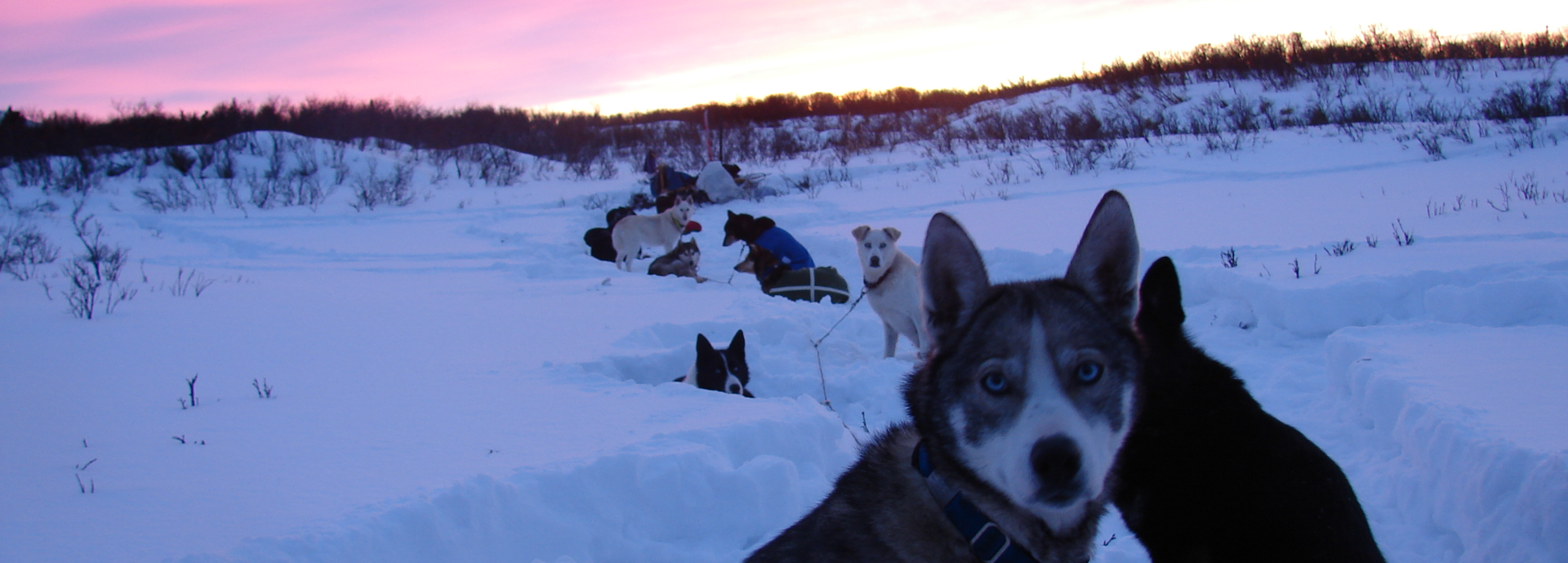
GinGin Starts

Visit http://www.denalihighwaytours.com/2011GinGinSpotTrackers.html and select Ilana’s name to track her progress. Use the “refresh” link to update status.

GinGin2011 Start

Already fading into the distant haze, Ilana is off to a good start in the GinGin 2011 Sled Dog Race

Posted in General | Leave a comment

GinGin SPOT trackers

It looks like this is the link that will be active during the GinGin200 sled dog race, which begins Wednesday December 28 2011 at 11am AKT: http://www.denalihighwaytours.com/2011GinGinSpotTrackers.html

Posted in General | Leave a comment

Greg Rescues Ilana’s Sled

I’m not sure how I did it, but before I headed out to the White Mountains I managed to put my sled on top of the dog box all by myself. I was so proud! We (Ilana and twelve Stinkypups) left our house at an early 12:00 noon and were headed to mile 42 of the Steese highway. The plan was to do a 55 mile mush in; rest; and mush out. The team was

  • Chevy & Nikki (lead)
  • Ahab & Shrek (point)
  • Maudie & Zeus (team)
  • Capella & Phanty (team)
  • Moe & Sno (team)
  • Spike & Luke (wheel)

By time we saddled up and left the parking lot it was 2:15pm. Chevy and Nikki were great leaders. We were there a previous year, so they knew the trail. I missed the turn I was supposed to take and Chevy lead me to a cabin we’ve stayed at before…Cache Mountain cabin. I decided to soup them at the cabin (a bit early…but twenty miles) and they were all great eaters! I was ready to head back to the truck if I missed the turn again on the way back, but Chevy listened to my “Gee” (turn right) and off we went. The trail was fine. A couple of icy areas and the rangers re-routed the route around McCay creek– so it was sort of funky with log bridges and turns. The long stretches of hill tired out the gang and I knew we wouldn’t make it to 55 miles in 6 hours, so I decided to stay at Moose Creek Cabin, which made it a 40 mile run (one way). I melted snow, souped the dogs, took a 4 hour rest, and off we went. At around 60 miles into the run Ahab looked bewildered and stopped pulling, so I put him in the sled for around 10 miles. When we fell over, I decided to try to put him in the team again and he did fine. I was a pleasant 80 miles mush and we were all so proud of ourselves, and tired.

Back at the truck, I put the dogs away and emptied my sled and tried to put the sled on top of the truck. I tried and tried and tried, but couldn’t lift that sucker high enough :(  It was 5:45am and there was no one on the secluded road to ask for help. I tried lifting, tugging, pulling, pushing for around 45 minutes and gave up! I decided to leave the sled there and go back with Greg later. Greg had to go to work though….so when I got home we chatted a bit, and then he made the three our drive (round trip), to rescue my sled and then went to work. Thanks honey!!!!!


Posted in training, trips | Tagged | Leave a comment

Dressing Warmly

To help some visitors to the land of the StinkyPups, here is some information about how we dress to keep warm during the winter. Everyone has their own system of different items, and of course the outside temperature, how long you will be out, and how active you will be are important determinants of what to wear. One key finding, after spending $thousands on winter gear in our last 9 years in Alaska, is that it’s very hard to tell how suitable, useful, comfortable, and functional an item will be until you try it. We’ve made plenty of trips to REI (in Anchorage or Seattle) and some of the local Fairbanks stores, trying on gloves, jackets, hats, etc. Gear that looks similar doesn’t perform similarly — we’ve found this especially with glove liners and gloves.

My (Greg’s) main activities outside are mushing (which is mostly standing on the back of a sled, occasionally helping the dogs) and dog care (includes wandering around the dog yard with a shovel, going for walks with pet dogs, etc.). I also often need to do outdoor maintenance, such as fixing fences and dog boxes, some truck care, etc.

We don’t really have brand loyalty, instead choosing what seems to work best. That said, Patagonia makes some excellent fleece products, including glove liners, pants, shirts, and light outer wear. Ilana has a great parka, and also our -40F sleeping bag, from Wiggy’s. We’ve bought many, many items from the Fairbanks-based Apocalypse Design, including jackets, mitts, hats and other items.

Layers: you probably already know about this. Different layers help trap heat, and allow for adjustment of different clothing types. I like to make sure I can open or close the neck of whatever I am wearing, which is my main temperature adjustment for working or mushing.

Materials: We avoid animal products, including wool & leather. Unfortunately, all the good socks we have found include wool. Otherwise, most gear is some sort of man-made fiber: polyester (or similar) fleece, nylon (or similar) outer shells. This is light-weight, dries quickly, and retains heat even when wet. In the base layer (the layer next to your body), it is excellent for wicking moisture away.

No sweat: If I am starting to sweat, due to exertion or being too warmly dressed, it’s important to immediately make adjustments. Usually this is a simple matter of unzipping my jacket or lifting the slide slaps on my hat. Doing larger adjustments (like removing an outer jacket) can be tough when standing on the back of a sled, so it’s better to have a simple system of adding ventilation.

Headgear: I seem to wear a hat year-round at the StinkyPup Kennel. Summer time it’s a cap, sometimes a mosquito net, to keep the bugs out. In the shoulder seasons (which don’t last long!), I have some light fleece caps, including one with a windproof liner. For winter, I almost always have TWO layers on my head. The outer layer is from Apocalypse. It’s a hat with an outer shell, velcro flaps to join under my chin (and completely cover my ears), a small brim, and a fleece liner. I have three hats, one that fits over a single layer, another for a bare head, and a third (for mushing at below -20 or so) that is big enough to accommodate 2 inner layers. These inner layers vary quite a bit, and I have several different ones I use. The main one for mushing is a face mask (integrated head; nose/mouth covering) from Turtle Fur. I sewed a fleece neck gator to the bottom, and also sewed a button snap to allow closing the gap over the bridge of my nose. This is a great setup, and works well for mushing. For set up, or walking around, I leave the nose snap open, and can even pull the mask down to expose my face. Layering the head is great for those cold days!

Hands: In early season, we have some fleece and cotton work gloves. For the winter, my choice is based on temperature. Below around 0F, I wear glove liners with an outer mitten. At warmer temps, glove liners with an outer fleece glove (from Apocalypse. My two favorite glove liners are either the wool liners from military surplus stores (thick, with a relatively open weave, and quite inexpensive), and a Patagonia brand. I can pull off the outer mitt/glove when needed, such as for putting booties on dogs. While mushing, we often use a chemical hand warmer inside our gloves, which helps keep them toasty.

Also, we have hand shells attached to our sled (and ATV) to keep the wind off of our hands. These are also seen on bicycles. Basically, they go around your handlebar, and reach a foot or so up your sleeve. Reach in to grasp the handlebar, and your hands & lower arms are protected.
Interestingly, I’ve found that my tolerance (or recovery time) for very cold hands has greatly increased since living in Alaska. My hands sometimes get too cold (such as, when holding a shovel for 1/2 hour without sufficient hand layers), but then quickly warm up when inside, or by making a fist inside of my glove, or a similar strategy. It used to be I’d get pins and needles, and hand pain, when recovering from a “too cold” experience. I’m not sure what’s changed, whether it’s psychology, physiology, philosophy, or simply having better gear to aid in re-warming.

Some mushers wear musher mitts, and these are used by snow machiners, too. These are big oversized mitts, with gauntlet sleeves. I have a pair, but find my system is sufficient for my expeditions. Musher mitts make it challenging to hold onto the sled handlebar, since they’re so thick and stiff.
Neck: As mentioned, I usually have a neck gator of some sort. This is just a band of fleece that goes around the neck (it can be raised up to cover the mouth, or even used as a makeshift hat, too). I don’t ever wear a scarf, instead I layer up with a high collar shirt (below), face protection, and some sort of zip-down outer layer. I wore a scarf in the past, and it was more hassle than these other options.

Torso: For everyday events, I have a cotton t-shirt with some sort of layer over it. For bigger exertions, I wear a breathable nylon shirt, short or long sleeved depending on anticipated temperatures and exertion levels. This is the same type of shirt I wear for jogging, and I have several variations. Basically, it’s a sports base layer.

The next layer could be a cotton sweat shirt for light exertion, but is more often a sweater or fleece layer. I have several different ones, depending on temperatures outside. Currently, I have a favorite long-sleeved fleece shirt from Patagonia, which has a zip-up turtle neck. This is ideal for temperature adjustment, and lets me create a complete seal against winds — and to let some air in, if needed, by zipping down.

I have a very heavy-duty Sherpa sweater that also has a zip-up collar. This one is too heavy to wear indoors.

For very cold mushes (-25F or colder) I add more, including a polyester fleece or other items as seem appropriate. Mushing at -35 or so is an exercise in layers, combining multiple items. At that temperature, I’ll often have a base layer of lightweight polypropylene long underwear, fleece pants, heavy sweater, vest, double-layered face protection (the inner fleece mentioned above, and an outer layer that is basically a nylon shell over fleece insulation), an outer hat … you get the idea.

Legs: Expedition weight fleece pants are a mainstay. Several vendors sell these, and mine are from Apocalypse. With my outer one-piece (below), these are all I need in most circumstances. For warmer weather, I have some regular sweat pants. For colder weather, I can layer a lightweight polypropylene underwear, as needed. I usually have cotton underwear briefs, but for bigger exertion or longer outings instead wear some polyester running shorts.
Outer shell: Ilana and I have made-to-order body suits from Apocalypse. These are amazing pieces of gear, and basically integrate a bib (which is the lower half, sort of like ski pants) with a heavy jacket. Lots of pockets. Reflector tape. Hood. Ilana got from fun-fur (non-animal fur-like material) to make a ruff on her hood. My hood is, unfortunately, too tight to wear over other layers. If I ever do a big expedition, I will need to get a good hood. All the mushers, seemingly, swear by them.
My one-piece uses double fleece layers, the same as the -50F jackets from Apocalypse. Ilana has a single fleece layer, which is consistent with their -20F jackets. This item is the one I always wear if it’s 10-15F or colder. For shoulder seasons, I have an insulated Carhart one-piece, which is surprisingly good. Some people wear those throughout the winter, with appropriate layers under & over.

Footwear: Many mushers recommend bunny boots, which are military surplus items with great features. They are usually white, they are sealed rubber around insulation. This keeps water out, meaning that if you get them wet it doesn’t impact their insulating quality. The two drawbacks of bunny boots (which I have, but only wear occasionally) are that they are very hard (so, rough for long standing and walking), and they tend to keep your foot moisture inside. This later point means that a long day’s exertion, even with good wicking socks or sock layers, is likely to end with damp feet.
Instead, I wear what are known as pack boots. I need to replace these every year or so, as the outer shell tends to get quite damaged through wear (for example, I often drag my boots to slow the sled. For example, accidentally stomping on the sled brake and piercing my other boot, instead). They have an outer shell with several layers of nylon and insulation. The inner liner is removable, conforms to the size of your foot, and can be replaced separately. The sole is very thick, with inner insulation and a reflective inner liner. My last three pairs have been from Baffin Technologies, and are rated to -100F. For mushing, get the coldest-rated boot available!

How long does stuff last? Glove liners get damaged easily by clips and other sharp objects in the dog yard. Even if they last without major holes, they wear thin fairly quickly. Plus, they are thin enough material that they are hard to sew (at least for me). Otherwise, there would be a great potential for taking damaged fingers from one glove, and replacing them with intact fingers from another older glove. Barring that, glove liners don’t last more than a few months. So, we go through 4-6 pairs per season. Outer fleece gloves, similarly, last well under a year. Thick fleece mitts tend to last several years, and usually die an ignoble death by being eaten by dogs (they seem to think big fleece mitts are related to bunny rabbits).

Boots last a season or so, maybe a little longer.

Jackets, hats, etc. with an outer shell (like the Apocalypse gear) lasts for many years. Holes can be patched (with sew-on patches, not iron-on), and duct tape works as an interim patch. Eventually, sun and other elements, and occasionally washing (we usually wash these a few times per year) start to wear the outer layer thin, and makes it harder to patch holes.

Fleece pants don’t last as long as I’d like, usually around 2 years before they have holes and thin spots.
Other fleece layers (gators, underwear, etc.) last many years.
Bottom line is, for our (rather extreme) weather situations and outdoor exertions, we need to continually re-invest in new and replacement outdoor gear.

I hope this is helpful to readers! There are many places to find advice on winter gear, and so I wanted to share some of my own experiences. The most important item I have to share is: until you try something, in the outdoors, under extreme cold conditions, for many hours of exertion, you will not know whether it is sufficient for your needs. Even the best gear might not fit you well enough to keep the cold out. And even the best brands, and most expensive items, are no guarantee of outstanding performance.

Posted in mushing, weather | Leave a comment